
Staring at that blank scholarship essay prompt feels like staring into the void, doesn’t it? You know this one piece of writing could literally pay for your college, but somehow your brain just… stops working.
Here’s the thing about learning how to write a scholarship essay – most advice out there is garbage. People tell you to “be yourself” and “tell your story” like that means anything when you’re competing against thousands of other kids who also have stories.
The reality? Scholarship committees are tired. They’re reading essay after essay about dead grandmothers, mission trips, and kids who “just want to help people.” Your job isn’t to have the saddest story or the highest GPA. Your job is to not be boring.
What These Committees Actually Care About
Stop thinking scholarship committees are looking for saints. They’re not. They’re looking for someone who won’t waste their money and who represents whatever their organization cares about.
Some scholarships exist because some rich guy wants to help kids from small towns. Others exist because a company wants future employees. Some are just tax write-offs that happen to help students. Figure out which one you’re dealing with, and you’re already ahead of 90% of applicants.
The essays that win money have three things going for them: they’re real (not fake-inspirational), they’re specific (not generic fluff), and they connect the dots between who you are and who you’re becoming.
Think about it – if you had to read 200 essays about teenagers who want to change the world, which ones would you remember? Probably the ones that made you think “huh, that’s different” or “I didn’t expect that.”
Different Essays, Different Strategies
Not all scholarship essays are asking for the same thing, so don’t write the same essay for everything.
Personal statement essays are the “tell us about yourself” ones. These seem easy but they’re actually the hardest because you have too many options. The key is picking one thing about yourself and going deep, not trying to cover everything.
Career goal essays want to know where you’re headed. Don’t just say “I want to be a doctor.” Tell them why, how you figured that out, and what you’re actually going to do with that degree. If you’re going into a field where companies that pay for college are common, mention that – it shows you’ve done your homework.
Community impact essays are about what you’ve done for other people. But they don’t care about how many hours you volunteered. They care about what you learned and how it changed you.
Subject-specific essays are tied to your major. These are your chance to geek out a little and show you actually know something about your field.
Figure Out What You’re Going to Write About
Before you start writing, you need to dig around in your own life and find the good stuff. Most students skip this step and end up with boring essays because they picked the first thing that came to mind.
Make three lists. First, write down everything significant that’s happened to you – good and bad. Don’t just put down the obvious stuff like making varsity or getting good grades. Think about smaller moments that actually mattered.
Second, figure out what you actually care about. Not what you think you should care about, but what actually makes you angry or excited or curious.
Third, think about what you want your life to look like in 10 years. Not just your job, but how you want to spend your time and what problems you want to solve.
| What to Think About | Questions That Work |
| Your experiences | What’s something that happened to you that most people don’t know about? When did you completely change your mind about something? |
| What you value | What’s something you see that makes you mad? What achievement are you actually proud of (not the one that looks good on paper)? |
| Your goals | What’s broken in the world that you want to fix? What do you want to be known for? |
| The connections | How did your experiences shape what you care about? How do your values drive your goals? |
This is where you find the connections that make your essay interesting. Maybe your part-time job taught you something about economics that connects to your major. Maybe a family situation gives you perspective that shapes your career goals.
Your Opening Has to Grab Them
Your first paragraph is everything. If it’s boring, they stop reading. If it’s generic, they forget you immediately.
Don’t start with “Education has always been important to me” or “I have always wanted to help people.” Everyone starts with that stuff. Start with something that could only come from your life.
Start with a moment. A conversation. A realization. A failure. Something specific that sets up the bigger story you’re going to tell.
One student started with “The first time I got fired, I was more relieved than upset.” That’s interesting. You want to know why. Another started with “My little brother taught me more about patience than any adult ever did.” That works too.
You could also start with a scene – put the reader somewhere specific. “The pharmacy was busier than usual for a Tuesday morning, and the woman at the counter was crying” immediately puts you somewhere and makes you curious about what happens next.
Whatever you pick, make sure it connects to the main point of your essay. Don’t start with something random just because it sounds interesting.
How to Write a Scholarship Essay Structure That Actually Works
Once you hook them, you need to keep them reading. The best scholarship essays follow a simple structure: setup, development, payoff.
Setup is where you establish what your essay is really about. This isn’t just background – it’s the foundation that makes everything else matter. If you’re writing about leadership, setup might be the moment you realized that being in charge doesn’t make you a leader.
Development is the meat of your essay. This is where you show growth and learning through specific examples. Don’t tell them you learned about responsibility – show them the time you had to choose between something you wanted and something you needed to do.
Payoff connects everything to your future and explains why this scholarship matters. This isn’t just listing your career plans – it’s showing them what they’re investing in.
Throughout the whole thing, get specific. Instead of “I learned about leadership,” try “I learned that real leadership means admitting when you don’t know something.” Instead of “I want to help people,” try “I want to design buildings that can withstand earthquakes because no kid should lose their school the way I did.”
Stop Being Vague About Everything
The difference between essays that win and essays that don’t usually comes down to specifics. Vague statements could apply to anyone. Specific details can only come from your life.
When you write “I learned the value of hard work,” that could be anyone. When you write “I learned that getting up at 4 AM to bake bread teaches you more about commitment than any motivational quote ever could,” now you have something.
This goes for everything in your essay. Instead of saying you want to “make a difference,” describe the exact problem you want to solve. Instead of claiming you’re “passionate about learning,” give them an example of when you stayed up late researching something just because you were curious.
Use your senses. What did things look like, sound like, smell like during important moments? These details make your story stick in people’s minds.
Numbers work too. “I volunteered at the animal shelter” becomes much better when you write “After 80 hours at the animal shelter, I learned that the dog who seemed the most aggressive was usually just the most scared.”
Connect Your Past to Your Future
Scholarship committees are investing in who you’re becoming. You need to draw clear lines between your experiences and your goals.
This doesn’t mean everything has to directly relate to your major. The teamwork you learned playing sports might help you in business school. The patience you developed tutoring kids might serve you well in research. Make these connections obvious.
Think about the skills and perspectives your experiences gave you. How do these prepare you for what’s next? How do they shape what you want to do with your life?
Don’t worry if your goals have changed. Actually, that’s good – it shows you’re capable of learning and growing. The student who started out wanting to be a doctor but discovered they’re more interested in public health hasn’t weakened their case. They’ve shown they can adapt and think critically.
When you talk about your goals, be specific but flexible. Show that you understand what your chosen path involves, but also that you’re open to learning more. Committees want to support students who will make the most of their education, not ones who think they have everything figured out.

Spending Money on Scholarship
While you’re thinking about scholarships, consider the bigger financial picture. Understanding how much to save for college helps you speak intelligently about your educational investment and shows committees you’re thinking seriously about costs.
Some essays ask directly about your financial situation. When they do, be honest but focus on your goals rather than just your problems. Show that you understand education is an investment and that you have a plan for making it work.
Talking About Money Without Sounding Desperate
| What They Want to Know | How to Address It | What It Sounds Like |
| Do you understand the costs? | Show you’ve done research | “Based on current tuition rates and living expenses…” |
| Do you have a plan? | Mention specific strategies | “I’m planning to work part-time and have applied for work-study…” |
| Is this worth it? | Connect funding to impact | “This scholarship would let me focus on my studies instead of working extra shifts…” |
| What’s your long-term thinking? | Link to career goals | “By graduating with less debt, I’ll have more flexibility to pursue public service work…” |
Mistakes That Kill Your Chances
Some mistakes show up in essay after essay. Avoid these and you’re automatically ahead of most applicants.
- Don’t try to be someone you’re not. Committees can spot fake inspiration from a mile away. Even real achievements sound hollow when you oversell them.
- Don’t just list your accomplishments. Your essay isn’t a resume. They want to know what they’re getting for their money, not just what you’ve already done.
- Don’t be vague about your goals. “I want to help people” describes half the applicants. Get specific about what problems you want to solve and how.
- Don’t ignore the basic stuff. Typos and formatting errors make you look careless. Not following instructions makes you look like you can’t read.
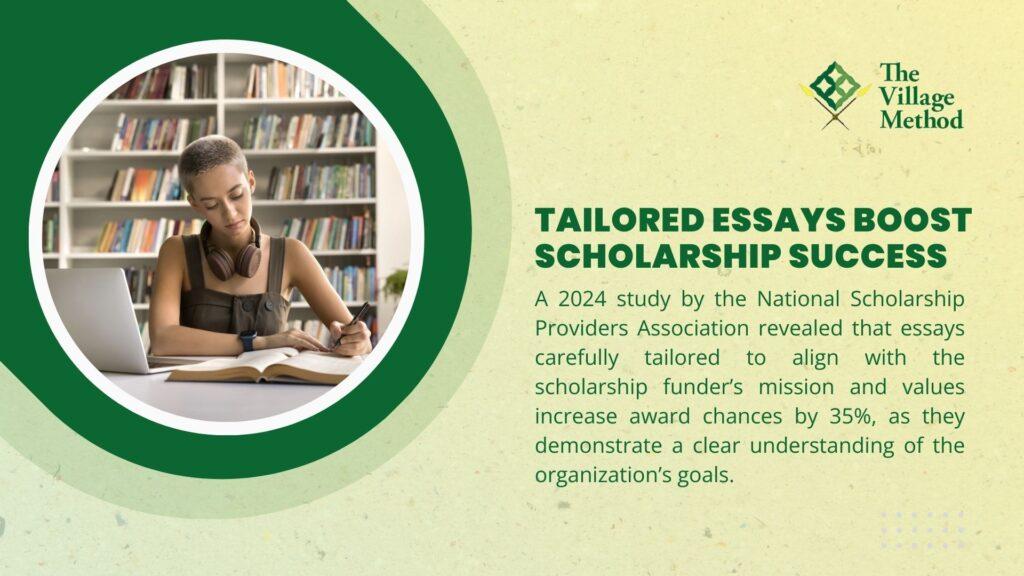
- Don’t write the same essay for every scholarship. Tailor your approach to match what each organization cares about.
Making It Better: The Revision Process
Your first draft is just the beginning. Good essays become great essays during revision.
- Read your essay out loud. If you stumble over sentences, fix them. If something sounds awkward to you, it’ll sound worse to them.
- Check against the prompt. Did you actually answer what they asked? Did you stay within word limits? Does your essay match what this particular scholarship is looking for?
- Look for places to add specifics or cut fluff. Every sentence should either move your story forward or support your main point. If it doesn’t do either, cut it.
- Pay attention to how your paragraphs connect. The reader should be able to follow your logic easily from beginning to end.
Get feedback from someone who doesn’t know your whole story. Friends and family fill in gaps based on what they already know about you. A teacher or counselor who’s less familiar with your background can better spot where your essay needs more explanation.
Standing Out in a Sea of Applications
Memorable essays usually have one thing that sticks with readers after they finish. This might be an unexpected perspective, an unusual connection between ideas, or just a particularly vivid moment that shows who you are.
Don’t worry if your life doesn’t seem dramatic enough. Memorable doesn’t mean tragic – it means authentic and specific. The student who writes beautifully about learning patience while teaching their grandmother to text can be just as memorable as someone who overcame major obstacles.
Let your actual personality show through. Your essay should sound like you, not like what you think a scholarship winner should sound like. If you’re funny, be a little funny. If you’re more serious, embrace that.
End with something that lingers. Don’t just restate your main points. Leave them with a thought or image that sticks around after they move on to the next essay.

Win the Funding You Need
Writing scholarship essays that win takes work, but it’s worth it. One good scholarship can change your entire college experience.
If this feels overwhelming or you want help making your essays as strong as possible, you don’t have to figure it out alone. The Village Method specializes in helping students create scholarship applications that actually stand out.
Their approach has helped students win millions in scholarship money by focusing on authentic, strategic essays that showcase what makes each student unique. Whether you need help finding your story, structuring your essay, or polishing your final draft, they can help you turn your college dreams into reality.